What to Pack for Car Camping in Denmark: A Beginner’s Checklist
Packing for camping sounds simple until you start putting everything in the car.
Tent? Check.
Sleeping bags? Check.
Cooking equipment? Check.
Then somehow you arrive at your first campsite with all of that and realise you forgot a pillow.
That was us.
When we prepared for our two-week camping road trip around Denmark, we packed a lot. Some things turned out to be essential, some were surprisingly useful, and some we changed along the way after realising there was a lighter or easier solution.
Our packing system changed too. At first, we carried much more than we actually needed from the car to the campsite. By the end of the trip, we were organising clothes and food into smaller daily bags and leaving everything else in the car.
So this isn’t a checklist for ultralight backpacking.
This car camping checklist for Denmark is based on what worked for us, where we could store extra clothes, food and supplies in the car and carry only what we needed to our campsite.
You definitely don’t need everything here.
Use this checklist as a starting point and adjust it depending on your campsite, the weather, how far you’re walking from the car and how comfortable you want to be.
Jump to
- Tent & Sleeping
- Cooking, Food & Water
- Clothes & Danish Weather
- Toilet & Hygiene
- Electronics, Tools & Safety
- Comfort & Entertainment
- Packing & Organisation
- Complete Car Camping Checklist
- Printable Car Camping Checklist for Denmark
1. Tent & Sleeping
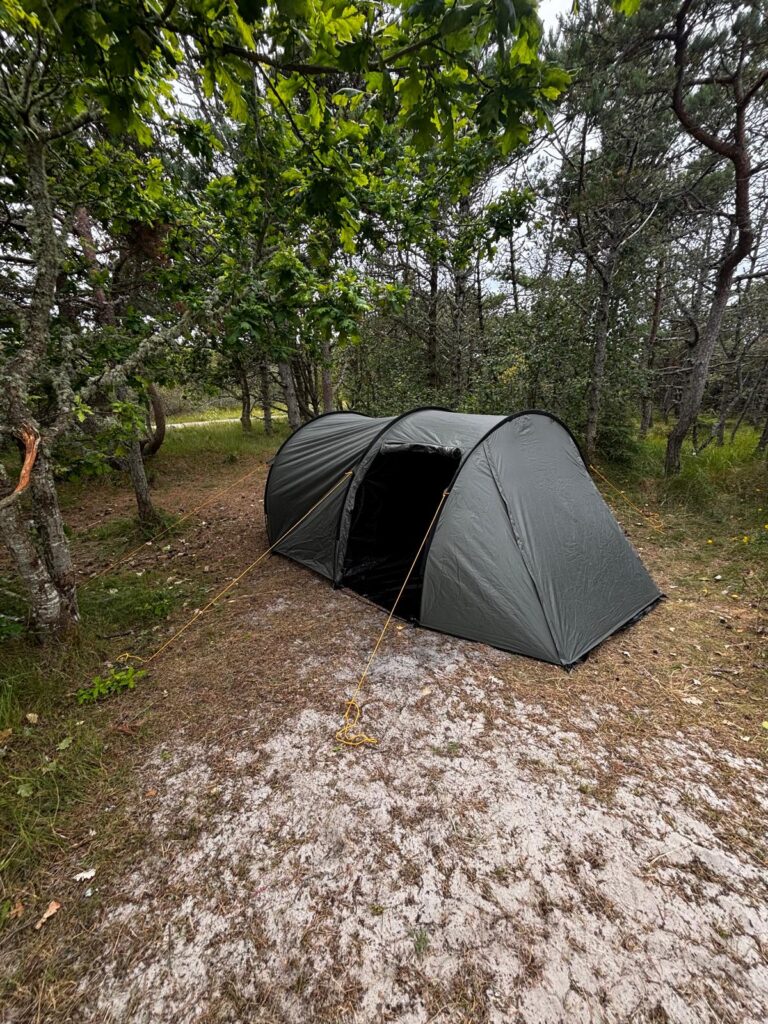
We bought a relatively inexpensive tent because we weren’t even sure whether we’d continue camping.
It was a little heavy, but for car camping that wasn’t a huge problem. And honestly, it has turned out to be great.
Our sleeping checklist
☐Tent
☐ Tent pegs and setup equipment
☐ Sleeping bag
☐ Sleeping mat
☐ Pillow
☐ Extra blanket
☐ Warm sleeping clothes
☐ Warm socks
☐ Tent lamp
☐ Flashlight
What we learned
Don’t underestimate your sleeping mat.
It’s not only there to make the ground more comfortable. It also helps insulate you from the cold underneath.
I’m sensitive to cold, so warm sleeping clothes, warm socks and a suitable sleeping bag also made a big difference for me.
And then there’s the pillow.
We somehow remembered the tent, sleeping bags, stove and everything else on our first night…
but forgot pillows.
That first test night at Hesteskoen taught us quite a few things about what we actually needed.
They’re now very firmly on the checklist. 😄
One more rule from me: ZIP THE TENT.
Every time.
You don’t want a bug surprising you while you’re sleeping.
2. Cooking, Food & Water
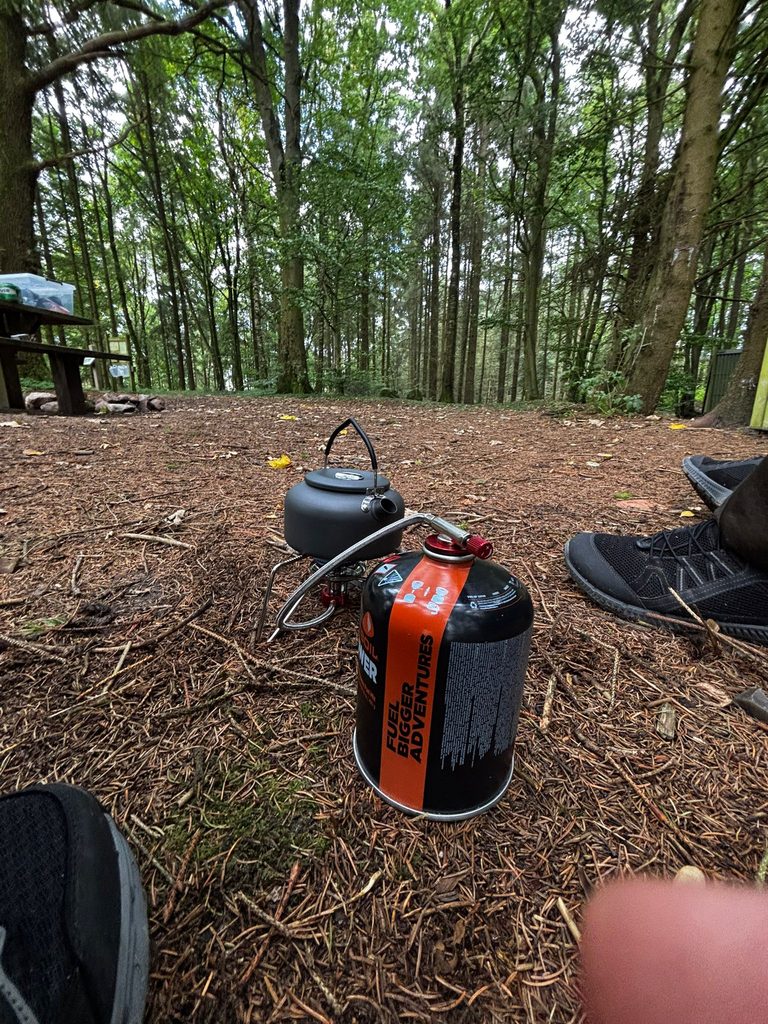
Our camping kitchen was actually quite simple.
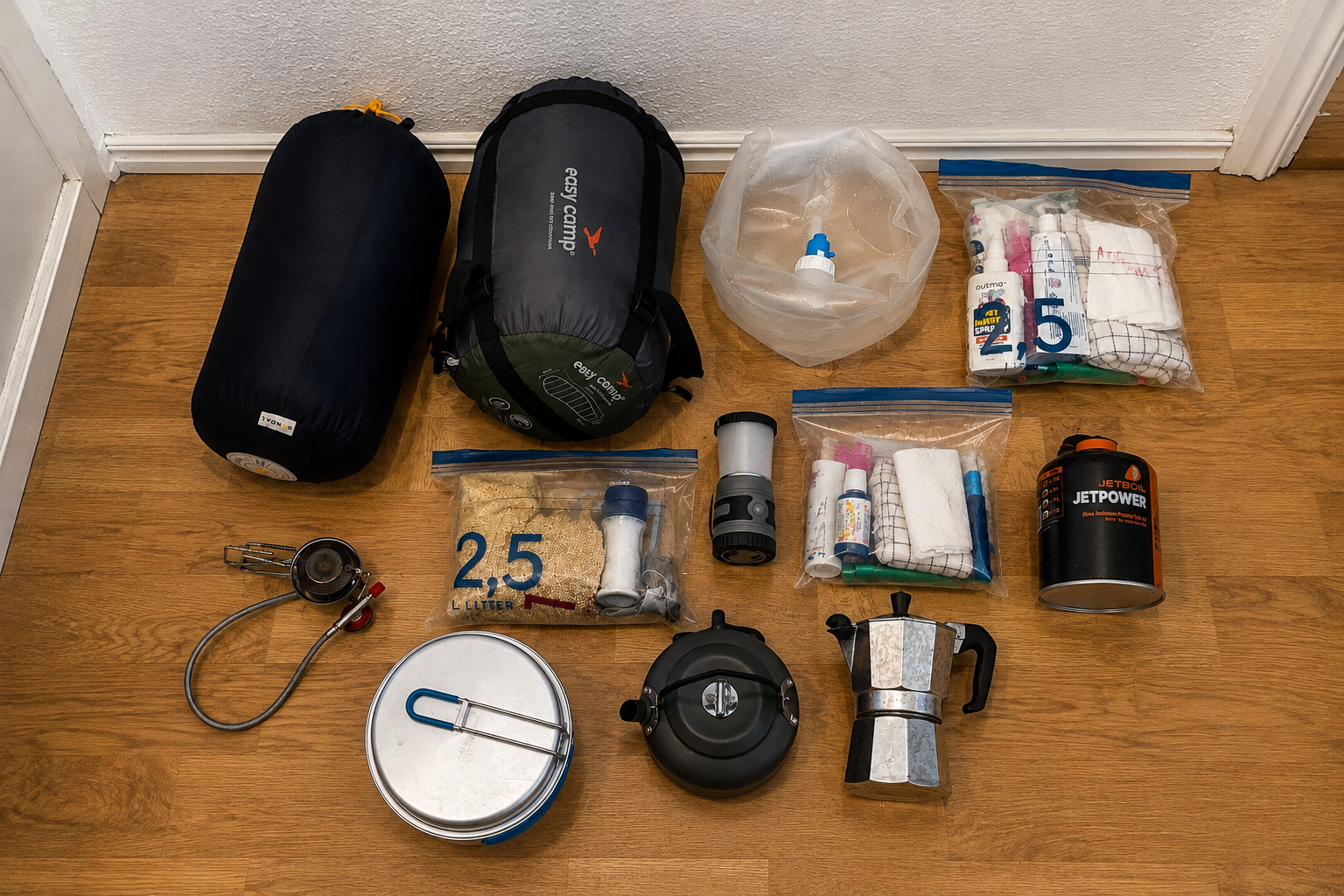
We used a small single-burner gas stove, camping pots and pans that fitted together, a small cutting board and only a few utensils.
Kitchen checklist
☐ Small camping stove
☐ Gas canisters
☐ Camping pot and pan
☐ Small cutting board
☐ One good knife
☐ Sporks or lightweight cutlery
☐ Wooden spoon or spatula
☐ Mugs
☐ Lighter
☐ Matches
☐ Dish soap
☐ Dish brush or sponge
☐ Dish towel
☐ Rubbish bags
☐ Aluminium foil
☐ Zip bags
At first, I brought normal cutlery from home. It worked, but it was unnecessarily heavy.
We later switched to sporks, which were lighter and easier to carry.
We also didn’t bring plates.
We simply ate directly from our camping pots and honestly never missed them.
I initially brought a big bottle of dish soap too. Later, I bought small travel containers and transferred just enough into one.
Much better.
A dish towel also became surprisingly important. When there’s sand and dirt everywhere and nowhere clean to leave wet dishes, drying them before packing them away makes life much easier.
Food & water checklist
☐ Drinking bottles
☐ Large water container
☐ Dry food such as pasta, rice or oatmeal
☐ Small selection of spices
☐ Coffee and tea
☐ Snacks
☐ Zip bags for meal portions
☐ Fresh food for the day
We didn’t have a fridge, so we generally bought fresh food during the trip and ate it the same day rather than keeping leftovers in the summer heat.
We also started dividing dry ingredients into smaller bags for individual meals instead of carrying whole packages to camp.
One of our most useful items was a 15-litre water container.
Very useful.
Also very heavy. 😂
But at campsites without drinking water nearby, having our own supply for drinking, cooking and cleaning was worth it.
What we learned: Always check whether your campsite has drinking water before you leave.
3. Clothes & Danish Weather
Camping in Denmark taught me not to trust summer too much.
Most of our trip was comfortable, but when we reached the west coast, especially around Thy National Park, it was colder and much windier than I expected.
Clothing checklist
☐ Waterproof jacket
☐ Windproof outer layer
☐ Waterproof/outdoor shoes
☐ Warm fleece or jumper
☐ Comfortable clothes
☐ Underwear
☐ Extra socks
☐ Warm socks for sleeping
☐ Sleep clothes
☐ Sandals or flip-flops
☐ Swimwear in summer
☐ Sunglasses
I especially liked having sandals or flip-flops around the tent.
Walking inside wearing your outdoor shoes is a very efficient way to bring half the campsite into your sleeping area.
We also didn’t carry all our clothes to camp every night. Most stayed in the car, and eventually we started putting the next day’s clean clothes into separate zip bags.
Dirty clothes went into another bag in the trunk.
Simple, but much easier.
4. Toilet & Hygiene
And now for the glamorous side of camping. 😄
If you’re staying at primitive campsites, don’t assume that “toilet available” means the bathroom you’re imagining.
I wrote more about our experience with primitive campsites and toilets in my beginner’s guide to camping in Denmark.
Sometimes the toilet is extremely basic.
Sometimes there isn’t one.
Hygiene checklist
☐ Toilet paper
☐ Wet wipes
☐ Hand sanitiser
☐ Small hand soap or paper soap
☐ Toothbrush
☐ Toothpaste
☐ Towel
☐ Shampoo
☐ Body wash
☐ Sunscreen
☐ Insect repellent
☐ Period products if needed
☐ Toilet trowel where appropriate
☐ Personal toiletries
Wet wipes were especially useful. Not only for toilet situations, but simply for cleaning yourself and feeling a little more refreshed when there wasn’t easy access to a shower.
I also switched from carrying larger bottles to smaller travel containers for things we only needed in small amounts.
For toiletries we didn’t need at the campsite, the full-size bottles simply stayed in the car.
And if you’re camping somewhere without toilet facilities, check the local rules and guidance before going to the toilet outdoors.
5. Electronics, Tools & Safety
We didn’t carry a huge survival kit.
Our phones were our main navigation tool, together with Google Maps and the information we checked for each campsite.
But a few small things were useful to have.
Our checklist
☐ Phone
☐ Charging cables
☐ Power bank
☐ Flashlight
☐ Spare batteries
☐ Multitool
☐ Knife
☐ Small scissors
☐ Tweezers
☐ Plasters
☐ Wound-cleaning supplies
☐ Painkillers
☐ Personal medication
A power bank was particularly useful because electricity isn’t something you can expect at primitive campsites.
The multitool, scissors and tweezers weren’t things we constantly used, but they’re small enough that I was happy to have them just in case.
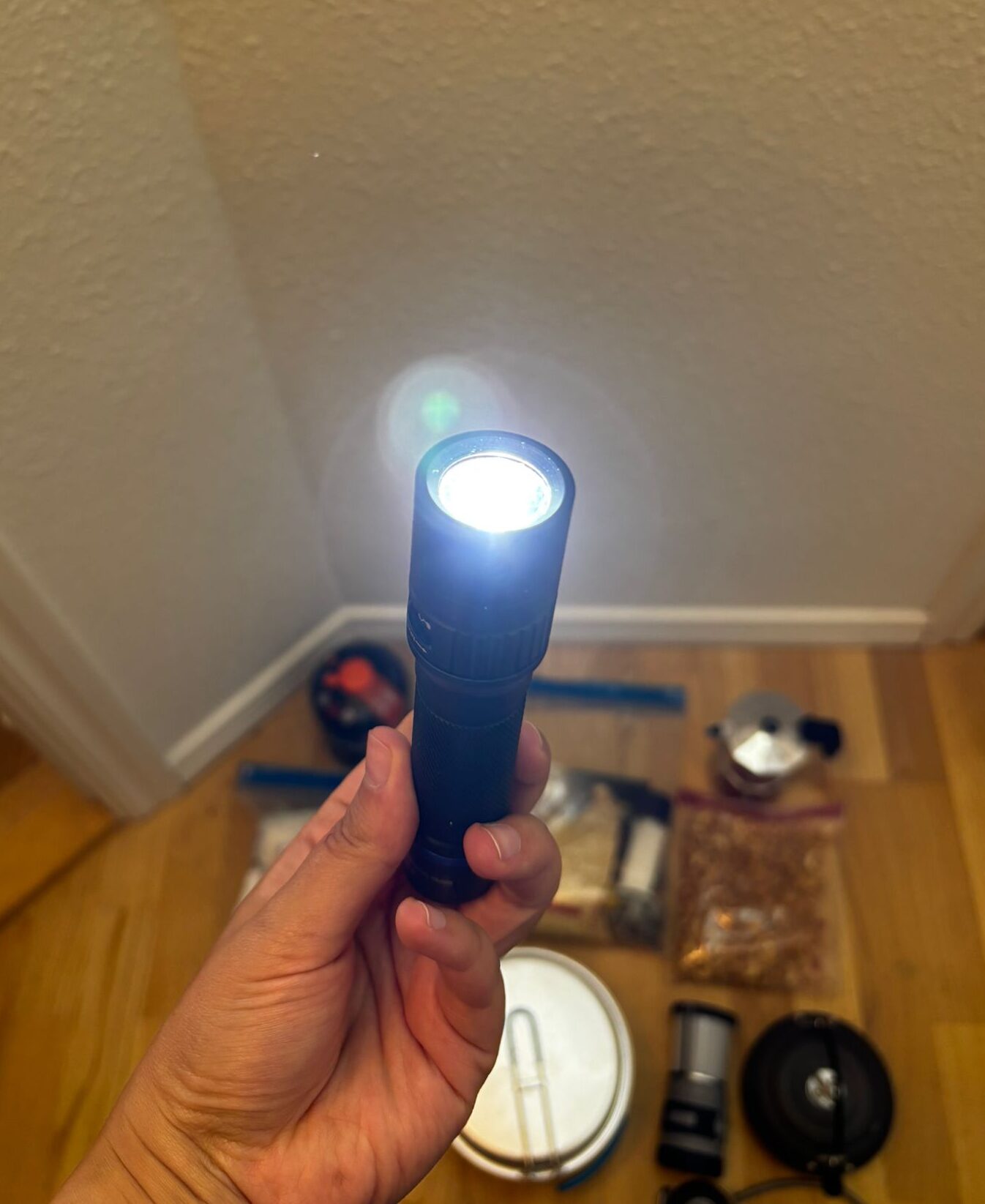
A flashlight is essential after dark
6. Camp Comfort & Entertainment
Some things aren’t strictly necessary.
But after carrying everything, setting up the tent, cooking and cleaning, there are things you’re very happy you brought.
Nice to have
☐ Camping chairs
☐ Small camping table
☐ Extra blanket
☐ Book
☐ Cards or small games
☐ Whatever you enjoy during quiet evenings
We had camping chairs from the beginning.
The table came later.
Some campsites have benches or picnic tables, but others don’t. After trying to prepare and eat things without a useful surface, a small table became much more attractive.
And bring something you enjoy doing.
A book, cards or a small game can be especially nice during long evenings.
You don’t have to spend every second dramatically staring into the wilderness. 😄
7. Packing & Organisation
This was probably the part we changed the most during our trip.
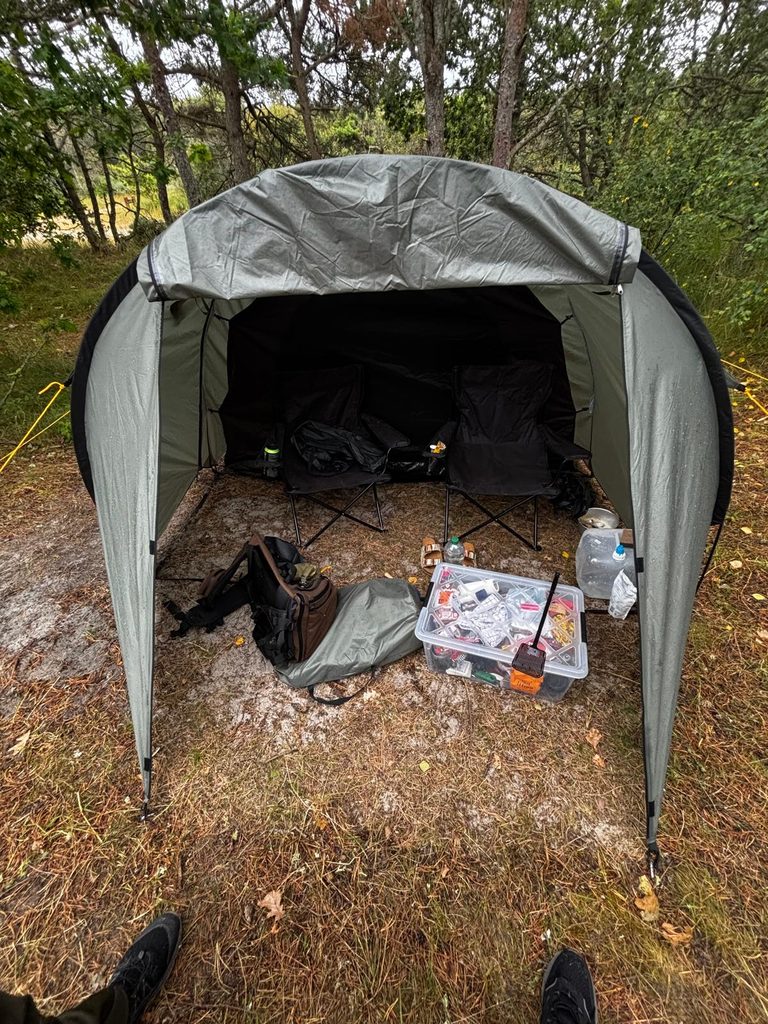
We had one large backpack and two storage boxes, plus the tent, chairs, sleeping bags, sleeping mats and our water container.
At first, we carried too much.
Eventually, we developed a much simpler system.
What stayed in the car
- Extra clothes
- Larger toiletries
- Extra food and supplies
- Dirty-clothes bag
- Anything we didn’t need that night
What came to the campsite
- Tent
- Sleeping equipment
- Next day’s clothes
- Food for the planned meals
- Cooking equipment
- Water
- Essential toiletries
- Chairs and other comfort items
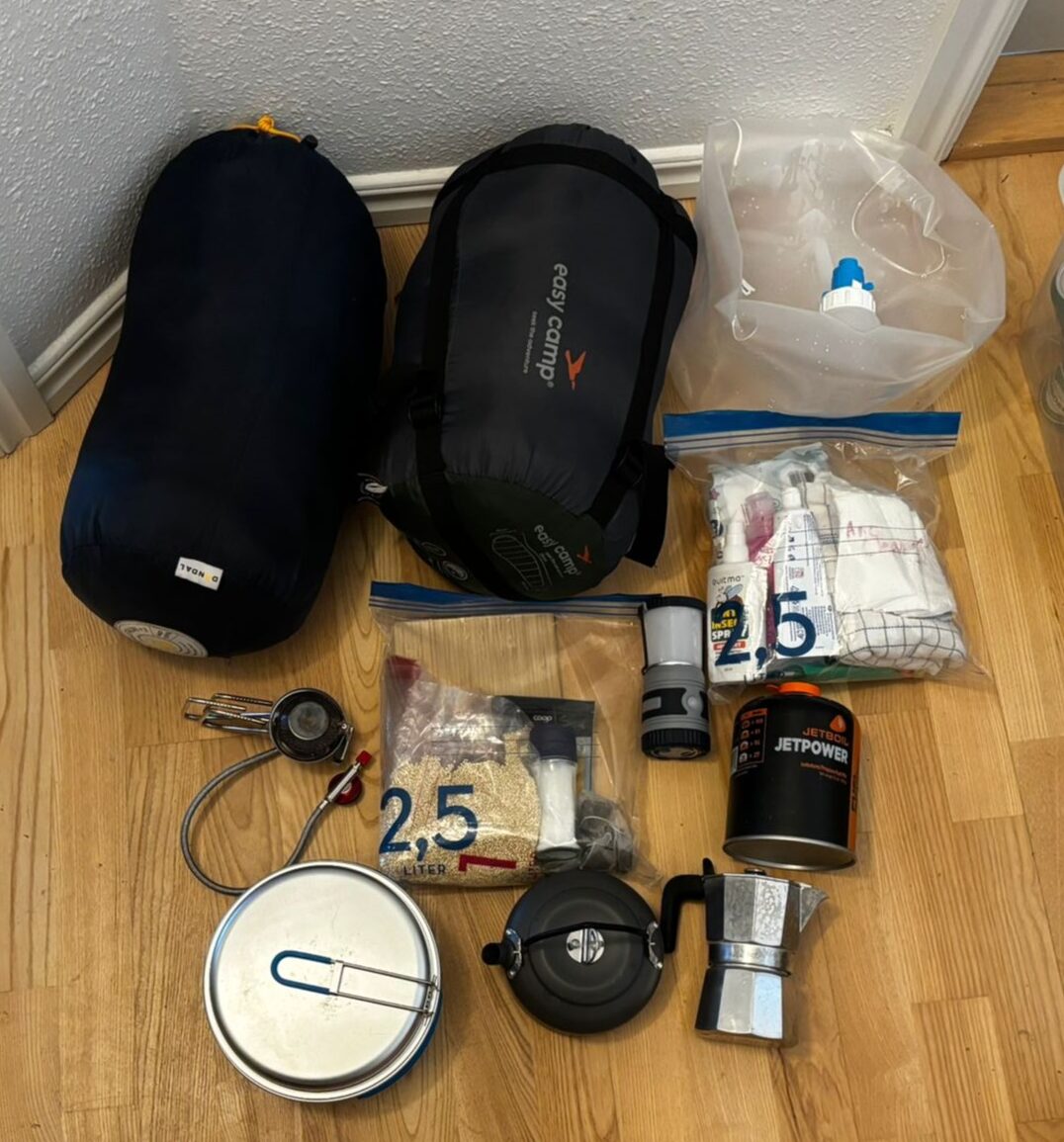
We also started repacking food into smaller portions instead of carrying entire packages.
One thing we’d still change is the backpacks.
Ideally, we’d have one good backpack each. That would make getting everything from the car to more remote campsites much easier.
Before choosing a campsite, check:
☐ How far is parking from the campsite?
☐ Is drinking water available?
☐ Is there a toilet?
☐ Is there a table or bench?
☐ Is booking required?
☐ Are fires allowed?
☐ What are the rules for firewood?
☐ What’s the weather forecast?
We never assumed we could simply make a fire or collect wood. At some places collecting suitable fallen wood was permitted, while at another campsite chopped wood was provided.
And bring rubbish bags.
Lots of them.
We kept extras in the car and packed our rubbish out rather than assuming there would always be a convenient bin nearby.
Check the rules for the specific place on Udinaturen or the campsite’s own website before you go.
The Complete Car Camping Checklist
If you’ve read enough and just want something to use while packing, here’s everything together.
⛺ Tent & Sleeping
☐ Tent
☐ Tent setup equipment
☐ Sleeping bag
☐ Sleeping mat
☐ Pillow
☐ Extra blanket
☐ Warm sleeping clothes
☐ Warm socks
☐ Tent lamp
☐ Flashlight
🍳 Cooking & Kitchen
☐ Camping stove
☐ Gas canisters
☐ Camping pot/pan
☐ Cutting board
☐ Knife
☐ Spork/cutlery
☐ Wooden spoon/spatula
☐ Mug
☐ Lighter
☐ Matches
☐ Dish soap
☐ Brush/sponge
☐ Dish towel
☐ Rubbish bags
☐ Aluminium foil
☐ Zip bags
🥫 Food & Water
☐ Drinking bottles
☐ Large water container
☐ Dry food
☐ Spices
☐ Coffee/tea
☐ Snacks
☐ Fresh food
👕 Clothes
☐ Waterproof jacket
☐ Windproof layer
☐ Waterproof/outdoor shoes
☐ Warm layer/fleece
☐ Everyday clothes
☐ Underwear
☐ Extra socks
☐ Warm sleeping socks
☐ Sleep clothes
☐ Sandals/flip-flops
☐ Swimwear if needed
☐ Sunglasses
🚿 Toilet & Hygiene
☐ Toilet paper
☐ Wet wipes
☐ Hand sanitiser
☐ Soap
☐ Toothbrush/toothpaste
☐ Towel
☐ Shampoo/body wash
☐ Sunscreen
☐ Insect repellent
☐ Period products if needed
☐ Toilet trowel where appropriate
☐ Personal toiletries
🔦 Electronics, Tools & Safety
☐ Phone
☐ Charging cables
☐ Power bank
☐ Flashlight
☐ Spare batteries
☐ Multitool
☐ Knife
☐ Small scissors
☐ Tweezers
☐ Plasters
☐ Wound-cleaning supplies
☐ Painkillers
☐ Personal medication
🪑 Comfort & Organisation
☐ Camping chairs
☐ Camping table
☐ Extra blanket
☐ Book/cards/games
☐ Backpack
☐ Storage boxes
☐ Bags for daily clothes
☐ Dirty-clothes bag
☐ Small bags for food portions
Before You Go
One final check:
Weather ✓ Water ✓ Toilet ✓ Parking ✓ Fire rules ✓ Booking ✓
Looking at the full list can make camping seem like you need to bring your entire house with you.
You don’t.
We didn’t have the perfect setup when we started, and we still don’t.
Some things were added because we discovered a problem along the way. Others became unnecessary once we found a simpler solution.
That’s part of figuring out what your version of camping looks like.
If you’re travelling by car, use the car as part of your storage. Don’t carry everything to the tent just because you packed it.
And if you forget something?
Hopefully it’s not your pillow. 😄