Camping in Denmark for Beginners: What I Wish I Knew Before My First Trip
Camping looks surprisingly simple when you watch someone else doing it.
You find a beautiful place, set up a tent, make coffee outside and spend the evening looking at the trees
Then you try it yourself.
Suddenly you’re researching where you’re legally allowed to sleep, wondering whether “toilet available” means the kind of toilet you’re imagining, carrying a box that seemed perfectly lightweight when it was sitting in your car, and discovering that somehow you remembered a camping stove but forgot a pillow.
That was more or less how I started camping in Denmark.
I had watched a few camping videos before our first trip, but there wasn’t much specifically about Denmark, and I had no real idea how camping here actually worked.
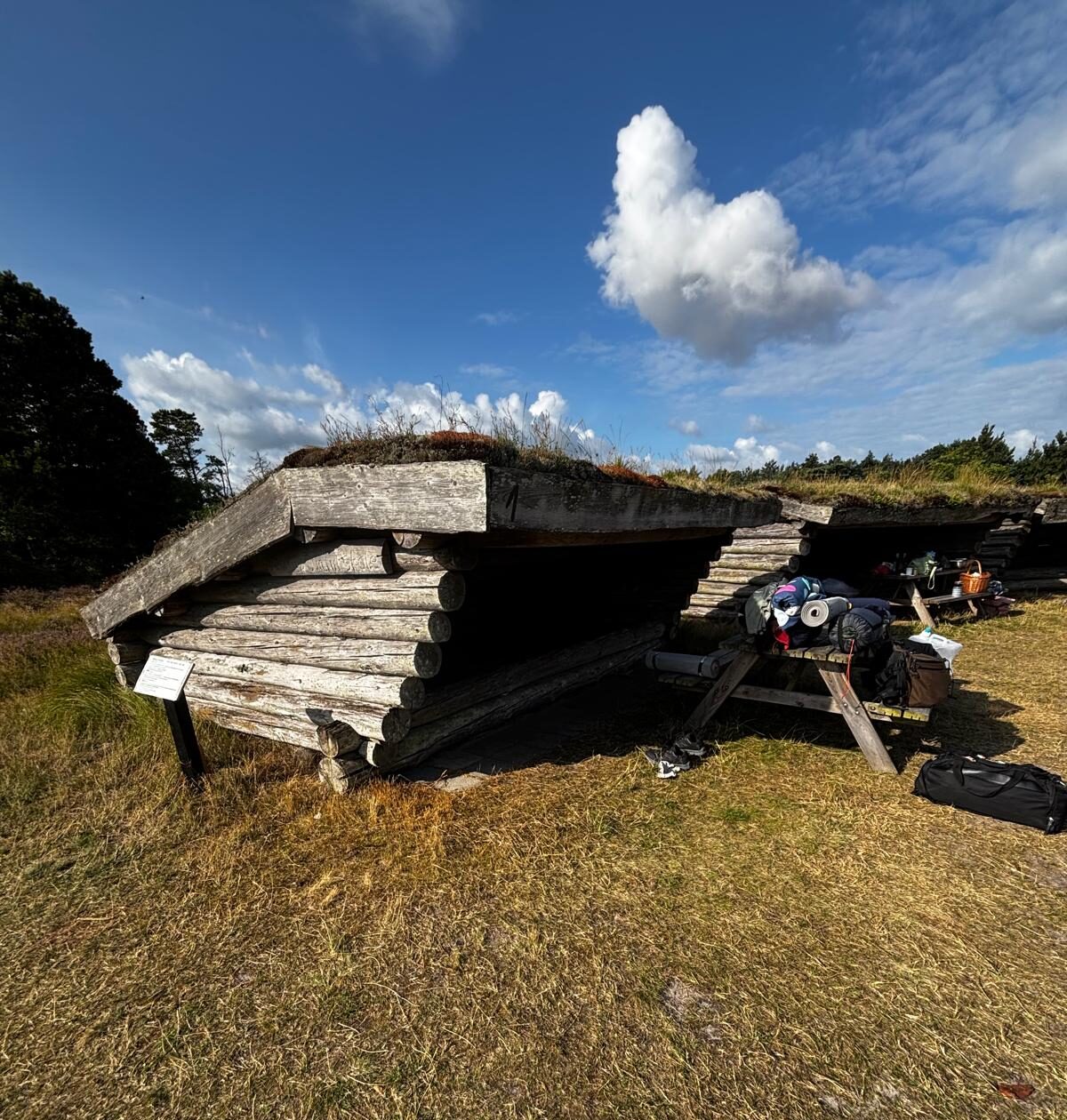
Since then, we’ve tested different places, travelled along the west coast, stayed at primitive campsites and in a shelter, cooked without a fridge, changed our packing system several times and learned that some of the smallest details can make a surprisingly big difference.
I’m still learning.
So this isn’t a guide from someone who has been camping for twenty years.
It’s the guide I would have wanted to read before I started.
If you’re looking for camping in Denmark for beginners, this is the guide I wish I’d had before my first trip.
Jump to
- Finding Somewhere to Camp in Denmark
- You Don’t Need Professional Camping Gear
- You Will Forget Something Obvious
- Think About Carrying Your Gear
- Food Without a Fridge
- Primitive Toilets Are Actually Primitive
- Don’t Underestimate Danish Weather
- Learn the Rules, But Don’t Be Intimidated
- Camping Is Relaxing… Eventually
- Would I Recommend Camping in Denmark?
1. Finding Somewhere to Camp Was the Most Confusing Part
Before we started, a Danish friend told me there was a website where I could find places to camp.
That was basically all I knew.
While searching online, I found plenty of traditional campsites with showers, kitchens, toilets and lots of facilities.
I’d stayed at places like that before.
They’re comfortable, but that wasn’t really what we wanted for this trip.
We were planning to travel for longer, so price mattered. But I also wanted fewer people, more nature and more of that feeling of actually being outdoors rather than sleeping at a holiday park.
Eventually, almost randomly, I discovered Udinaturen.
And at first?
I found it overwhelming.
There were different types of places, different icons, different rules, information about parking, shelters, tents, booking…
It took some time before I understood what I was actually looking at.
But once I learned how to use it, everything became much easier.
Now I can usually find a place very quickly, check whether I can pitch my own tent, see whether booking is required, find parking information and check what facilities are available.
One important thing I’ve learned is that every place is different.
Don’t find one primitive campsite, understand its rules and assume the next one works exactly the same way.
Some have drinking water.
Some don’t.
Some have toilets.
Some definitely have very primitive toilets.
Some shelters can be booked.
Some places are first come, first served.
Sometimes you can pitch a tent.
Sometimes there are specific restrictions.
And parking might be beside the campsite… or surprisingly far away.
The Danish Nature Agency itself distinguishes between small primitive campsites, larger group campsites and designated fri teltning forests. Small primitive campsites may have water and primitive toilet facilities and generally allow tents, while free tenting has its own specific rules.
My advice?
Read the information for the exact place you’re planning to use.
Don’t assume.
We learned that one very quickly.
2. You Don’t Need Professional Camping Gear to Start
One thing I’m really happy we did was not spending a fortune on equipment before our first trip.
We didn’t even know whether we would like camping.
So buying expensive professional equipment made absolutely no sense to us.
We bought most of our first equipment from Bilka and Biltema and spent roughly 5,000 DKK altogether.
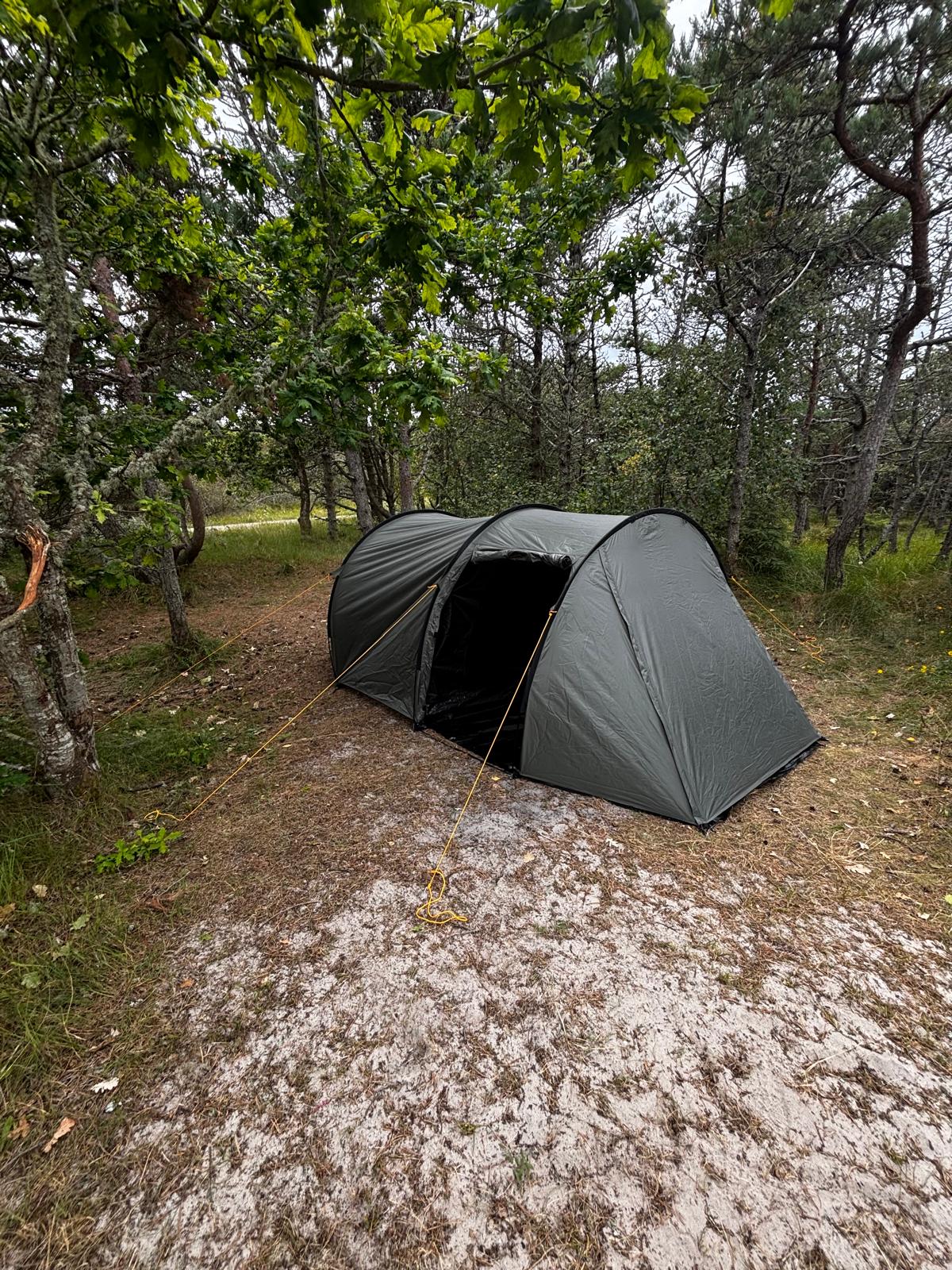
Our tent was relatively cheap.
It was also a little heavy.
But you know what?
It turned out to be great.
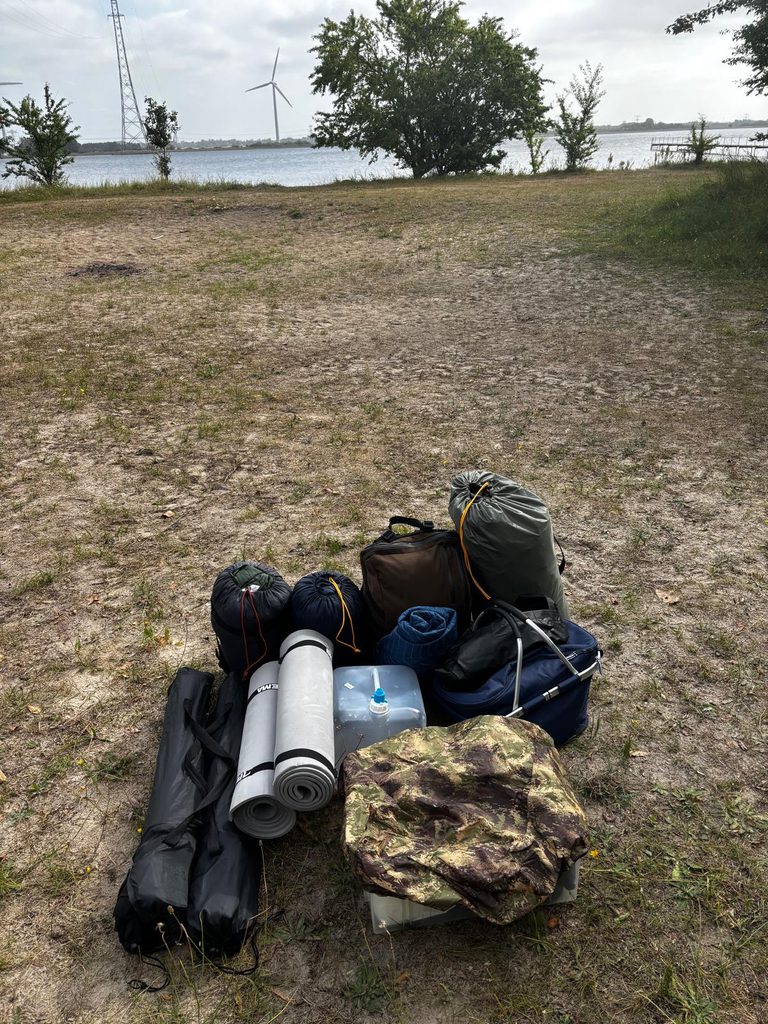
It was easy for two complete beginners to set up, gave us enough room for our equipment and survived our summer camping trip perfectly well.
We followed the same philosophy with most of our equipment:
Start relatively cheap.
Use it.
Learn what annoys you.
Then decide what deserves an upgrade.
Because before camping, I thought I knew what features mattered.
After camping, I had completely different opinions.
For example, we bought a little lamp for inside the tent.
Great idea.
Except it produced so little useful light that if I wanted to read something, I practically needed to hold it beside my face.
So yes…
that one needs replacing. 😄
Meanwhile, our inexpensive tent, the thing I might have expected we’d need to upgrade first, has been completely fine.
3. You Will Forget Something Obvious
We spent quite a lot of time thinking about camping equipment.
Tent.
Sleeping bags.
Sleeping mats.
Cooking equipment.
Gas.
Warm clothes.
Food.
And then on our very first night at Hesteskoen…
we realised we’d forgotten pillows.
Not some specialist piece of outdoor equipment.
A pillow.
😂
Cooking revealed another collection of missing items.
We hadn’t brought cooking oil.
We needed something better for stirring food.
We hadn’t really thought properly about plates.
And after breakfast the next morning, we realised a small camping table would make life considerably easier.
None of these things destroyed our trip.
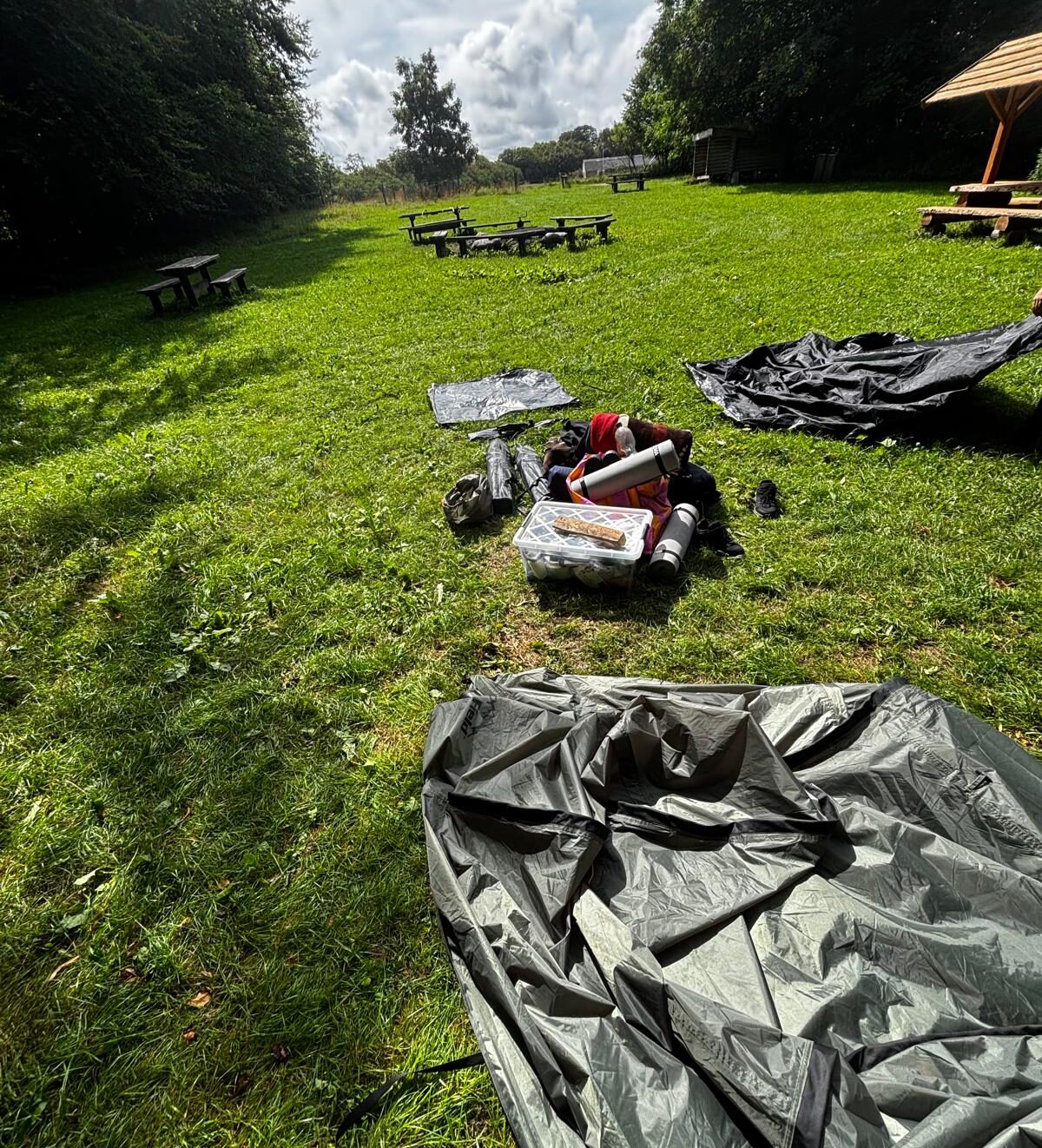
Actually, that was the whole reason we’d decided to do a test night close to home before travelling around Denmark.
Read about our first camping trip at Hesteskoen, where we tested our gear and discovered everything we’d forgotten.
It showed us what our imaginary packing list had missed.
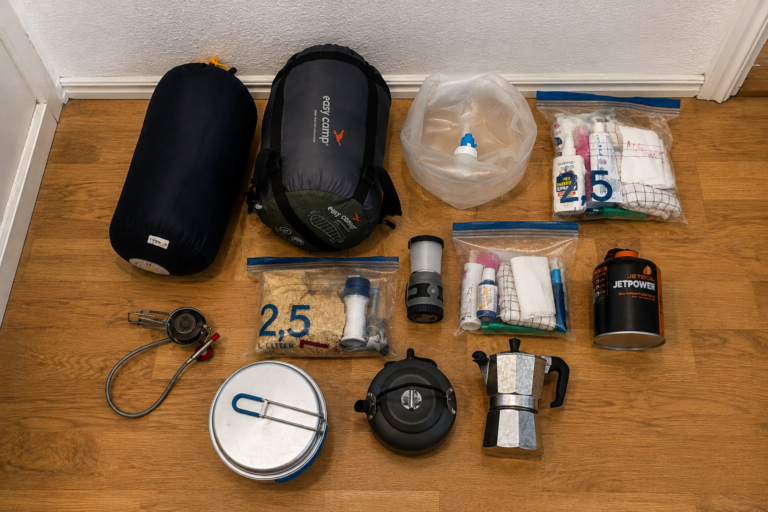
After two weeks on the road, that imaginary list became a much more practical one. I put everything we actually packed and learned into our car camping checklist for Denmark, including a printable version.
And I think that’s one of the best things a beginner can do.
If possible, don’t make your first camping experience a complicated week-long adventure far from home.
Try one night first.
You’ll learn more from those 24 hours than from watching another ten camping videos.
4. Carrying Your Gear Changes Everything
This was another thing I hadn’t properly considered.
You can fit something in your car.
Great.
That doesn’t mean you want to carry it for 20 minutes through a forest.
On our early trips, we used boxes for a lot of our equipment.
Boxes are wonderful when they’re sitting in the car.
Less wonderful when you’re carrying them along a trail.
After our first few camps, we completely reorganised how we packed.
We started leaving unnecessary things in the car, taking only the food and clothes we needed for that day, and repacking supplies into smaller portions.
We still want to improve this further and buy better backpacks.
But now, after a trip, we clean everything, reorganise it and store our camping equipment together so it’s much closer to ready to go next time.
And when you’re choosing a campsite, check the parking information.
Seriously.
A campsite that’s 200 metres from parking and one that’s 3 kilometres from parking are two completely different experiences when you’re carrying your temporary home, kitchen and bedroom on your back.
5. Food Without a Fridge Requires a Different Plan
Before the trip, we thought we’d probably buy lots of those convenient ready-made supermarket foods.
Then we looked at some of them and realised that many of the options we were considering didn’t really give us the kind of meals we wanted.
So we changed the plan.
Because we didn’t have a fridge and it was summer, we bought fresh food regularly and cooked it the same day.
Breakfast might be oatmeal, eggs and bacon, or something simple like bread with jam or peanut butter.
Lunch was usually quick. Sandwiches worked well.
Dinner was where we had more fun.
Steak.
Grilled sausages.
Beans and bread.
Chicken kebabs.
And whatever else we could figure out with a camping stove or fire.
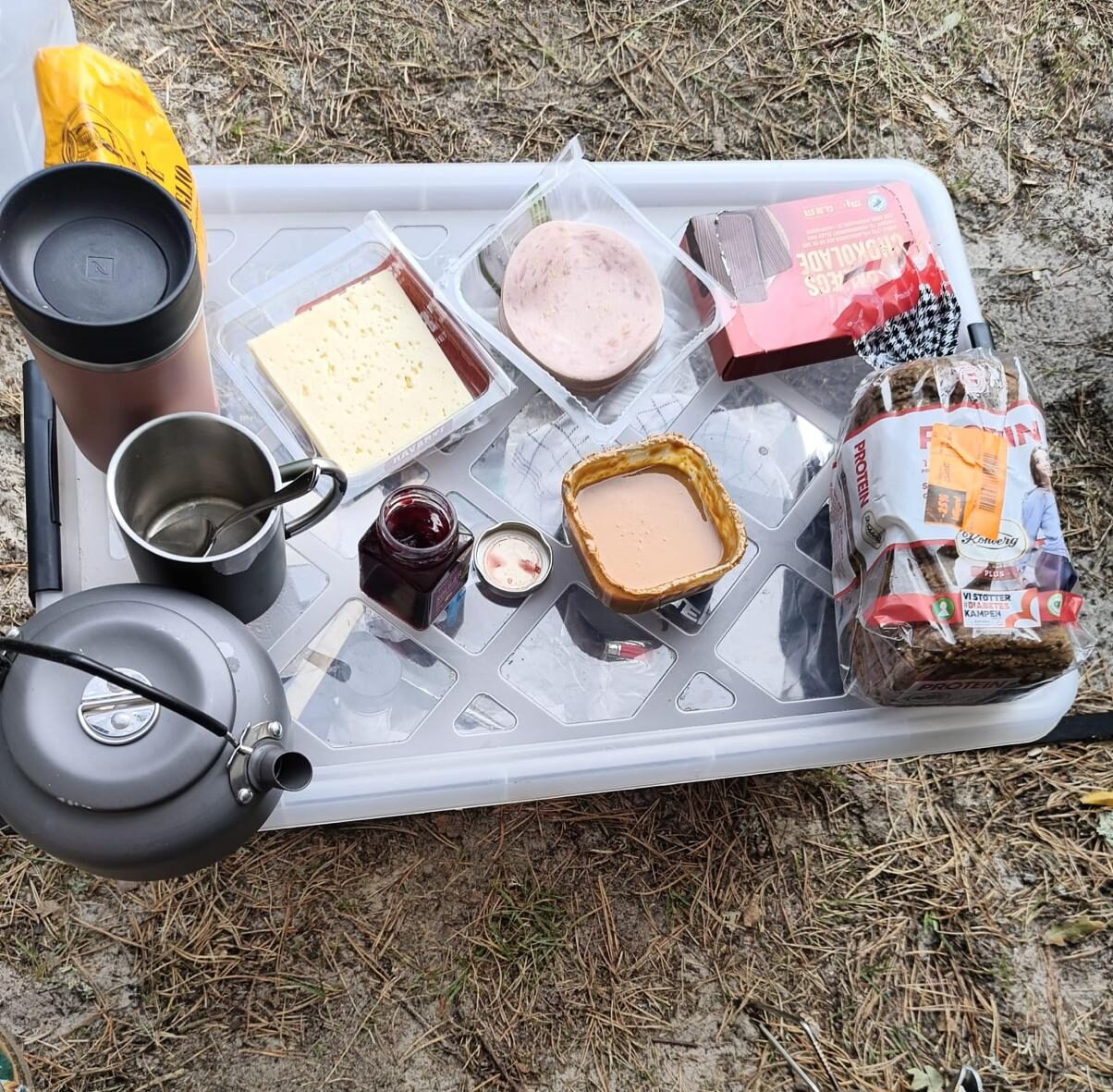
We didn’t use specialist camping meal bags.
And honestly, I didn’t feel like we needed them.
Cooking became part of the experience.
There is something very satisfying about making a proper dinner outside after you’ve spent the day walking and exploring.
Just remember the cooking oil.
I learned that one for you. 😄
6. “There Is a Toilet” Doesn’t Necessarily Mean What You Imagine
This deserves its own section.
When I was searching for campsites at the beginning, one of my filters was:
Does it have a toilet?
Simple.
Except I had a very normal toilet in my imagination.
That was my mistake.
Some of the primitive toilets we encountered were tiny, dark, damp and…
how should I say this politely?
Very memorable.
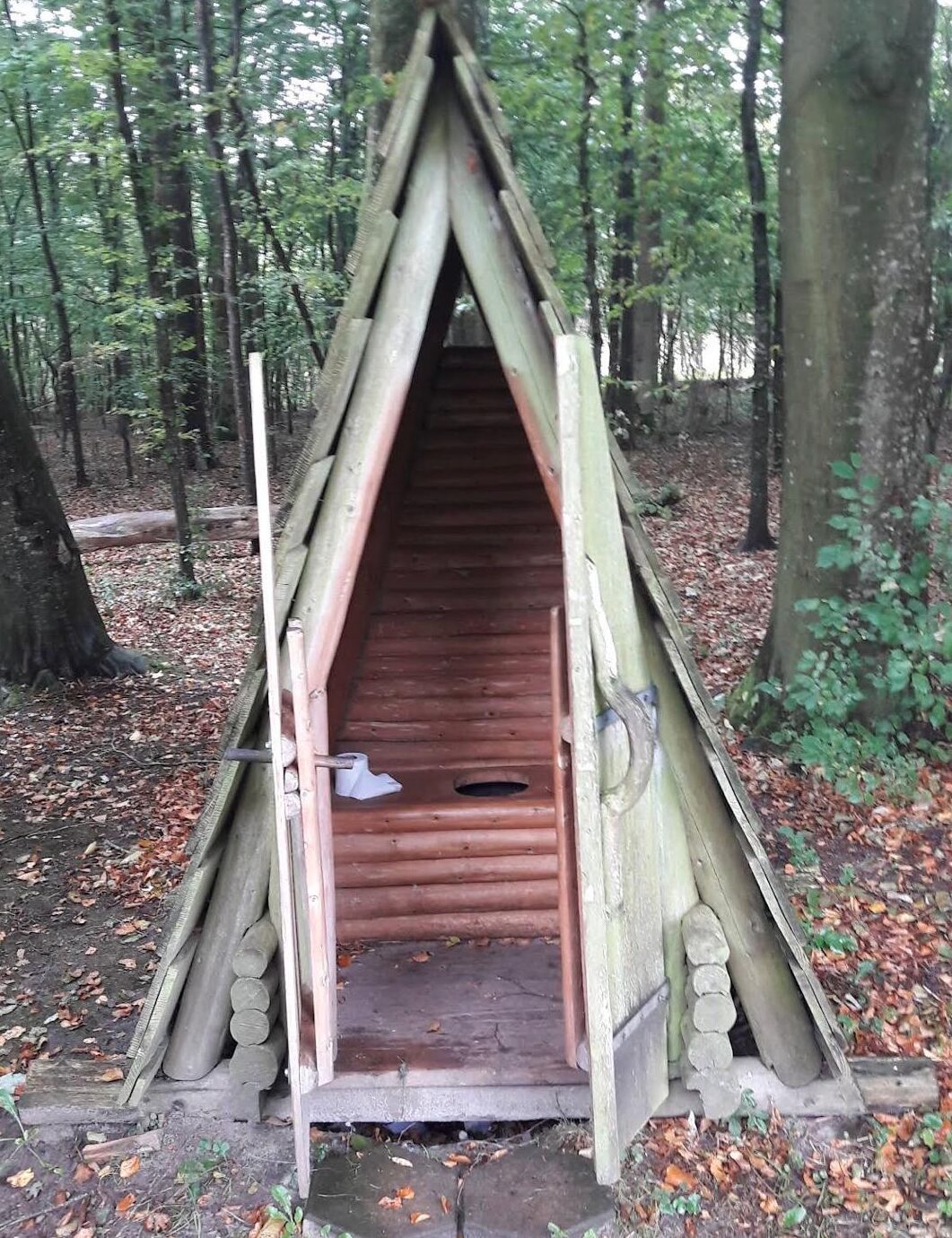
The smell could be difficult for me to tolerate.
Eventually I realised that I needed to treat toilet facilities as part of primitive camping rather than expecting anything resembling a normal campsite bathroom.
Some Udinaturen listings explicitly tell visitors to bring their own toilet paper and hand sanitiser, while other primitive sites have no toilet at all. The Nature Agency also advises leaving no trace if you need to use the forest as a toilet.
So now I’d rather be prepared.
Toilet paper.
Wet wipes.
Hand sanitiser.
And, where appropriate and permitted, the basic equipment needed to deal responsibly with going to the toilet outdoors.
Also, don’t assume there will be a rubbish bin.
We carried rubbish bags and generally preferred packing our waste out with us anyway. That’s also consistent with the Nature Agency’s leave-no-trace guidance.
Primitive camping means exactly that:
primitive.
Once I stopped expecting normal campsite facilities, it became much easier.
7. Summer in Denmark Doesn’t Mean Every Night Will Feel Warm
For most of our trip, the summer weather was completely manageable.
But then we reached the west coast.
Especially around Thy National Park, I noticed a difference.
More wind.
Cooler temperatures.
And that very open west-coast landscape where there isn’t always much between you and the weather.
Even in summer, I was glad we’d brought warm clothes.
I wouldn’t pack for camping in Denmark based only on what the weather feels like when you leave home.
Bring layers.
Have something wind-resistant.
And check the weather for where you’re actually camping, not only the nearest big city.
We also learned another weather-related lesson on our very first night.
When I woke up, the inside of our tent roof was wet.
My first thought was:
Is our new tent already broken?
No.
We hadn’t ventilated it properly.
Condensation.
Another lesson added to the list.
8. Learn the Rules, But Don’t Be Intimidated by Them
Before camping, I wondered whether Denmark would have lots of complicated rules about what you could and couldn’t do.
In reality, I haven’t found the rules unreasonable.
Most of them make sense.
Protect nature.
Respect other people.
Don’t leave rubbish.
Don’t damage trees.
Don’t make fires where fires aren’t allowed.
Use the designated areas properly.
And check the specific rules for where you’re staying.
For example, fri teltning in designated state forests follows the Nature Agency’s 1-2-3 rule: one night in the same place, no more than two tents together, and tents designed for no more than three people. Fires are only allowed at designated fire sites, and restrictions can become stricter during periods of fire risk.
That’s different from staying at a primitive campsite, which can have its own rules and facilities.
I don’t see these rules as annoying restrictions.
There is usually a reason for them.
We’re getting access to beautiful natural places, sometimes for free.
The least we can do is leave them the way we found them.
9. Camping Is Relaxing… Eventually
This might be the biggest thing I wish I’d understood.
You see beautiful camping pictures and imagine:
Tent.
Trees.
Coffee.
Sunset.
Peace.
And yes.
Those moments absolutely happen.
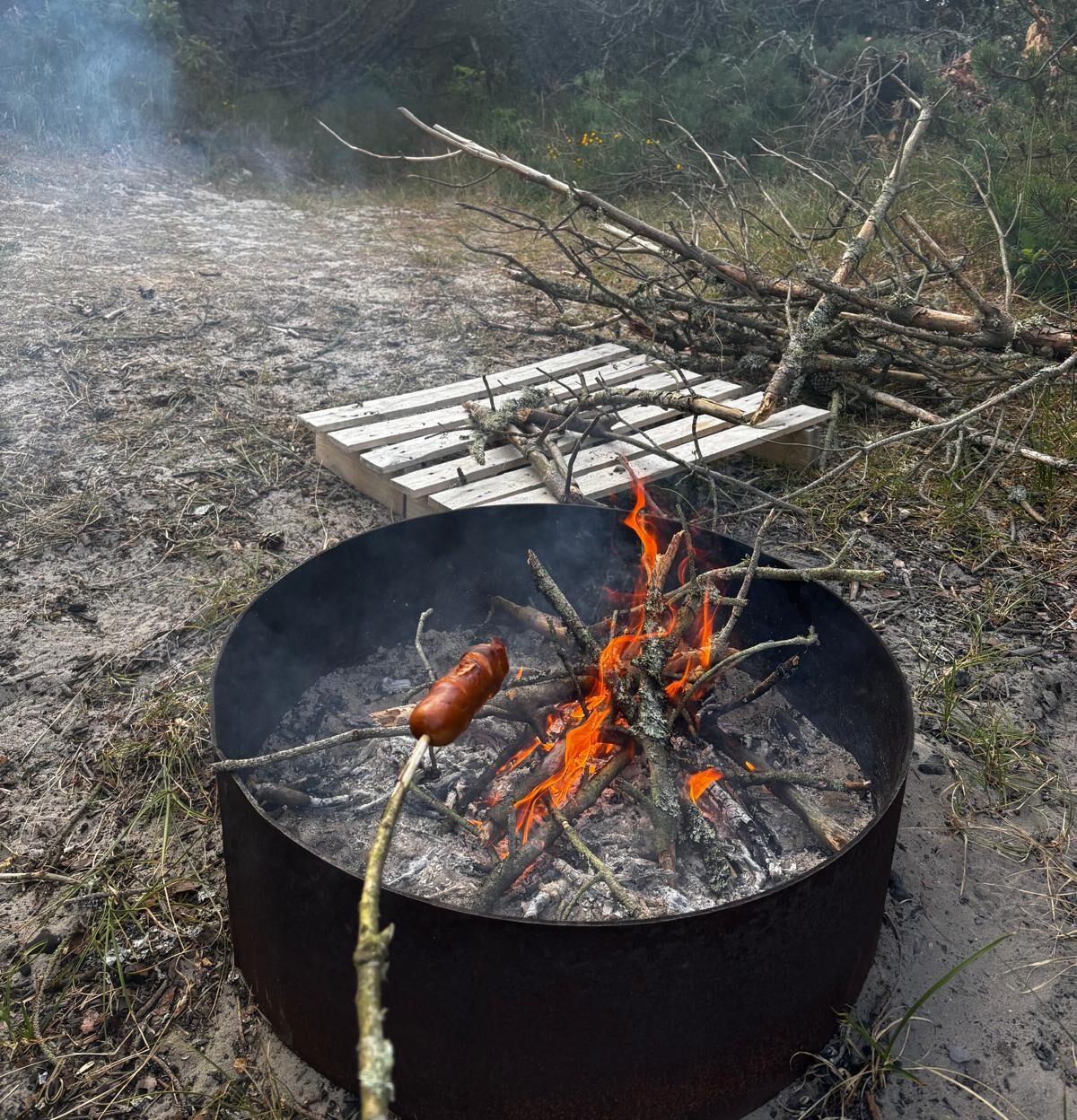
One of the good parts after camp is finally set upBut before the peaceful coffee comes:
Packing.
Driving.
Finding parking.
Carrying everything.
Finding the campsite.
Choosing a spot.
Building the tent.
Unpacking.
Cooking.
Cleaning.
Figuring out what you’ve forgotten.
And eventually doing all of that again in reverse.
Camping can be overwhelming, especially at the beginning.
But strangely, solving all those little problems became part of what I enjoyed.
My boyfriend and I had to work together.
We figured things out.
We changed our packing system.
We learned how to make our temporary little home more comfortable.
And then eventually everything was done.
We’d sit down, look at the tent we’d built together, listen to the sounds around us and realise:
We’re here.
No hotel.
No busy city.
No complicated plan.
Just us and whatever landscape we’d chosen for that night.
That feeling is difficult to explain until you experience it.
10. So, Camping in Denmark for Beginners: Would I Recommend It?
Absolutely.
But don’t expect your first trip to be perfect.
Actually, I’d recommend the opposite.
Expect to get something wrong.
Buy reasonable equipment rather than trying to create the perfect professional setup immediately.
Choose an easy first campsite.
Check parking.
Read the facilities carefully.
Bring warm clothes.
Have rubbish bags.
Prepare for primitive toilets.
And do a test night if you can.
Then learn.
Our equipment still isn’t perfect.
We’re still changing how we pack.
There are things we want to replace.
There are things we still want to buy.
And every campsite teaches us something different.
But that’s also why I’m enjoying it.
Camping isn’t just about sleeping outside.
For me, it’s the feeling of being completely in nature, working together, finding solutions when something doesn’t go according to plan, and then finally sitting down and enjoying this little temporary world you’ve built together.
And apparently all the packing, cleaning and questionable toilets haven’t scared us away.
We’re going camping again next weekend. 🙂